
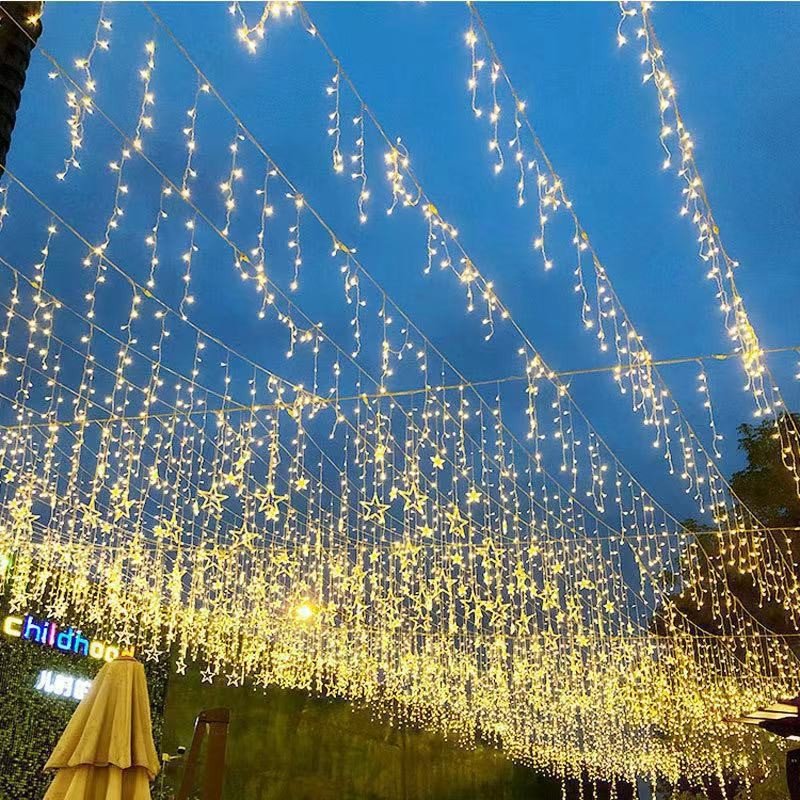
LED Icicle Lights for Pedestrian Promenade Canopies
Plan decorative overhead runs for pedestrian promenades using warm white icicle sets. Listed spans and drops support a measured section schedule; IP44 exposure review, access clearance and a configuration-specific power plan remain part of project approval.
TECHNICAL SPECIFICATIONS
Built for Commercial Decorative Lighting
Key specifications can be configured according to your market and project needs.
| Input Voltage |
24V ,110V ,220–240V |
|---|---|
| IP Rating |
IP44 |
| Light Color |
Warm White |
| Product Size |
3 × 0.8 m ,3 × 1 m ,3 × 1.5 m ,3 × 2 m ,3 × 3 m ,4 × 0.3 m ,4 × 0.6 m ,5 × 0.4 m ,5 × 0.8 m ,5 × 1 m ,6 × 0.5 m ,10 × 0.3 m ,10 × 0.5 m ,10 × 0.8 m |
| LED Quantity |
72 LEDs ,96 LEDs ,120 LEDs ,128 LEDs ,144 LEDs ,150 LEDs ,168 LEDs ,180 LEDs ,192 LEDs ,200 LEDs ,280 LEDs ,304 LEDs |
| Drop Pattern |
Wave ,Horizontal |
| Cable Color |
Transparent ,White ,Black |
| Cable Material |
PVC ,Rubber |
| Bulb Type |
LED |
| Control Mode |
8 Modes ,Steady On |
Make a Long Route Read as One Decorative Scheme
Promenade icicle canopies help define an overhead decorative route along a pedestrian street or landscaped walkway. The reference images show warm hanging points distributed above circulation space. For an installer or municipal-project supplier, the challenge is to turn that visual idea into sections that match the actual supporting geometry and can be inspected independently. To coordinate the overhead canopy with other lighting along the pedestrian route, explore commercial lighting solutions for the wider project.
This OSLENA listing concerns warm white icicle sets with selectable spans and drops. It is a configurable product family, not a complete engineered street installation. The mounting structure, exposure assessment and electrical distribution plan need their own approval.
Survey the Route in Manageable Sections
Identify changes rather than averaging the distance
Map straight runs, corners, entrances and changes in support height. A single overall route length can hide the places where a standard set will not fit. Record the clear width between the intended fixing lines and the available vertical envelope in each zone. Include signs, trees and street furniture that affect the arrangement.
Separate pedestrian clearance from decorative depth
Use the applicable site requirements to establish the lowest acceptable hanging point. The longer configurations should be considered only where the available space supports them. A photograph taken from below can make a drop look much longer or shorter than it is, so the measured survey remains the ordering reference.
Build a Span-and-Drop Schedule
Use the available pairings below as the starting list for section selection. The product size is written as width × drop, while the second column identifies the corresponding LEDs. All fourteen rows belong to the series; a project does not need to use every row.
| Product Size | LED Quantity |
|---|---|
| 3 × 0.8 m | 128 LEDs |
| 3 × 1 m | 144 LEDs |
| 3 × 1.5 m | 180 LEDs |
| 3 × 2 m | 200 LEDs |
| 3 × 3 m | 304 LEDs |
| 4 × 0.3 m | 72 LEDs |
| 4 × 0.6 m | 120 LEDs |
| 5 × 0.4 m | 96 LEDs |
| 5 × 0.8 m | 168 LEDs |
| 5 × 1 m | 192 LEDs |
| 6 × 0.5 m | 150 LEDs |
| 10 × 0.3 m | 120 LEDs |
| 10 × 0.5 m | 200 LEDs |
| 10 × 0.8 m | 280 LEDs |
Assign one selected pairing to each location code on the plan. Add the number of sets at that location and identify where a visible break is acceptable. Covering a physical distance with neighboring sets does not establish whether those sets may be electrically linked. Ask for the limits of the quoted voltage and connection build.
Decide How the Lower Edge Should Follow the Street
A wave pattern creates alternating depths along the decoration. A horizontal pattern creates a level outline. Consider whether neighboring sections should continue the same edge or intentionally mark separate zones. Show the preferred outline on an elevation drawing so the buyer and supplier can discuss it without relying on a general scene photograph.
Warm white gives this scheme a consistent color direction. If other street lighting is present, view a sample at the planned operating time. A lamp count is not a brightness specification, and a warm color name is not a numerical color-temperature guarantee.
Exposure Review Comes Before Installation Approval
Use IP44 as the starting rating
The offered rating is IP44. Describe the actual location, including rainfall exposure, irrigation, water accumulation and the placement of plugs or control equipment. Review each assembly component. A canopy structure may provide some shelter but does not automatically make the connections suitable for every condition.
Resolve the support and access method
The decoration should be fixed to an approved supporting system rather than treated as a load-bearing element. Agree how installers will reach each section for inspection. Seasonal schemes also need a plan for taking down the lights without dragging them through planting or placing stress on their cables.
Plan Power Access Without Hiding the Accessories
Quote 24V, 110V and 220–240V as separate input choices. Select the version that corresponds to the destination and design, then identify power accessories and plugs in the purchase schedule. Connection lengths, maximum linked sets and power distribution are configuration-specific information to request.
Cables can be Transparent, White or Black, using PVC or Rubber material. Choose the finish against the supporting structure and background, while asking for any environmental data the site requires. Neither material name alone establishes a temperature range or long-term outdoor qualification.
Steady On supports a constant promenade appearance. The 8 Modes alternative needs an agreed operating sequence. When several areas must behave alike, request confirmation of coordination capability rather than assuming synchronization, memory or centralized control.
Seasonal Handover and Next-Year Reuse
Record the approved set pairing, cable finish, voltage and supplied equipment for each street zone. Keep location labels consistent between the order, installation drawing and storage record. This makes it easier to identify a section when the route is rebuilt or a replacement is requested. Buyers sourcing several lighting categories can compare OSLENA’s decorative lighting products alongside the proposed promenade icicle canopy configuration.
Before storage, follow the supplied handling instructions and inspect the assembly. A project sample can help the crew agree on cable management and the intended appearance. This page does not promise a reuse lifespan, and recurring installation conditions should be discussed with the supplier.
Questions from Streetscape Buyers
Can set quantity be calculated from route length alone?
No. Include cross-route span, drop clearance, interruptions and the chosen layout. Physical coverage and permitted electrical connections are separate decisions.
Is decorative lighting a substitute for pedestrian lighting?
The series does not provide a functional street-lighting specification. Retain the site’s required illumination assessment independently.
What should the procurement package contain?
Send the section map, chosen size/count rows, Warm White color, pattern, voltage, cable choices and quantities. List controller, plug and power-accessory requirements, and describe the exposure conditions that require review.
Let’s Build Your Next Lighting Project
Tell us your application, target market, quantity and customization needs. Our team will recommend the right decorative lighting solution.