
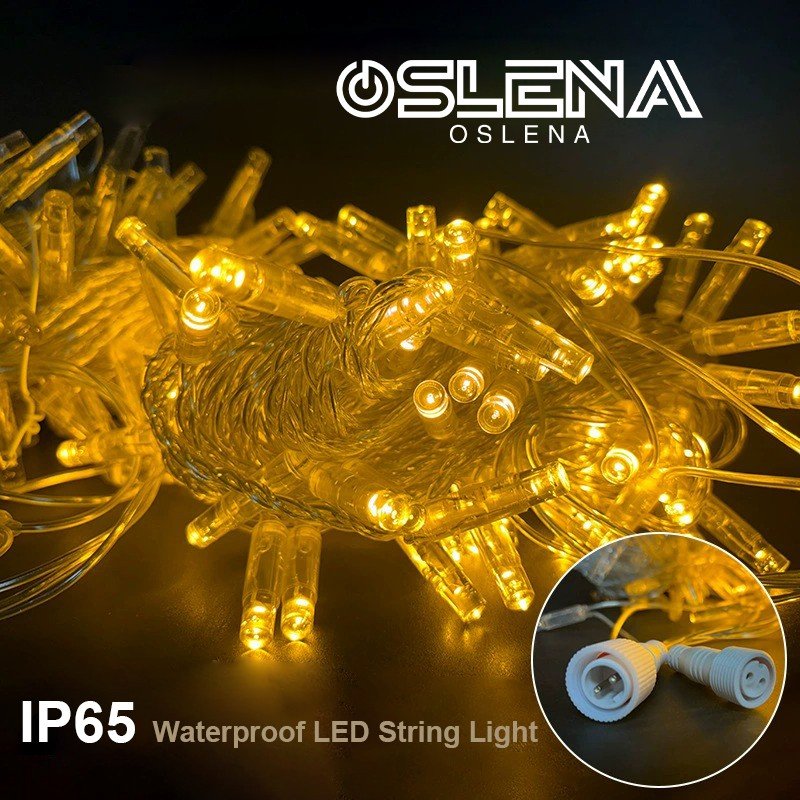
Amber IP65 LED String Lights for Retail and Architectural Displays
Amber-toned warm white IP65 LED string lights for retail features, façades and architectural decoration. OSLENA confirms project length, electrical details and wholesale packaging.
TECHNICAL SPECIFICATIONS
Built for Commercial Decorative Lighting
Key specifications can be configured according to your market and project needs.
| Input Voltage |
110–120V ,220–240V ,24V |
|---|---|
| IP Rating |
IP65 |
| Light Color |
Amber |
| Total Length |
100M ,10M ,20M ,30M ,50M |
| LED Quantity |
100 LEDs ,1000 LEDs ,200 LEDs ,300 LEDs ,500 LEDs ,800 LEDs |
| Cable Color |
Black ,Transparent ,White |
| Cable Material |
PVC ,Rubber |
| Bulb Type |
LED |
| Connectable Quantity |
5–6 Sets |
| Control Mode |
8 Modes ,Steady On |
Integrating Amber String Lights With Retail Architecture
Amber IP65 LED string lights bring a richer, warmer accent to commercial façades than neutral or cool white lighting. They are suitable for boutique entrances, timber-fronted restaurants, heritage-style shopping areas and architectural display details. The colour direction and IP rating are confirmed; every electrical, dimensional, cable, control and packaging choice is established for the specific building or distribution market.
Match Amber to the Building Material
Amber often complements timber, brick, bronze and dark stone. It can soften a contemporary shopfront or reinforce a traditional architectural character. Designers should view a sample beside the real finish because surface colour and nearby lighting change the perceived result. The goal is a coordinated façade, not simply a bright line applied without material context. To coordinate the amber outline with the façade materials and other decorative features, review commercial lighting solutions for the wider project.
Identify the Feature Hierarchy
An entrance frame, window outline, cornice and landscape element should not all compete equally. Mark the primary feature and supporting lines on an elevation. This helps decide where closer LED spacing is useful and where a lighter treatment is enough. A clear hierarchy can reduce unnecessary product while giving the most visible architectural detail greater emphasis.
Measure Corners, Returns and Setbacks
Architectural perimeters include corners, recesses and transitions that are easy to miss in a front-view measurement. Record every section and show where the light begins, changes direction and ends. Include the route from the power point. This prevents a nominal façade length from becoming an inaccurate strand requirement once real three-dimensional geometry is considered.
Protect the Daytime Retail Presentation
Shops and restaurants are evaluated while the lights are off, so cables, connectors and fastenings should remain orderly beside the finish. Share close views of mounting surfaces and any landlord or conservation restrictions. The listed cable colors are Black, Transparent and White; PVC and Rubber are the material choices. Select the offered combination and confirm connector construction and attachment details against the actual visual and practical limits.
Plan for Cleaning and Maintenance Access
Retail façades may be washed, repainted or accessed for signage work. Position strands and joints so authorised teams can inspect them without dismantling major architectural elements. Avoid unserviceable connections inside drainage paths. The installer should document the route and retained spare components so later maintenance does not rely on memory or disturb unrelated features.
Interpret IP65 in the Full Electrical Context
The string light itself has a confirmed IP65 rating. Plugs, controllers, power units and extension connections require protection suitable for their location. Voltage, rated power, plug, operating mode and permissible linking quantity are selected for the target market and layout. IP65 does not authorise an exposed connection or replace local electrical review.
Managing an Architectural Lighting Order
Retail fit-out contractors, design suppliers and decorative-lighting importers can request this amber product by drawing or stock specification. OSLENA records the confirmed colour and rating, then reviews strand length, LED interval, lead wire, cable, electrical build, control, packing, labelling and market documents before providing the final commercial offer.
Approve an Elevation and Physical Sample
A marked elevation should identify product routes and version codes. A physical sample can then confirm amber tone, point spacing, wire appearance and connector detail against representative materials. Retain both references with the purchase order. For expansion to another branch or later refurbishment, they provide a stronger basis than the phrase same amber lights.
Separate Custom Runs From Standard Stock
A named façade may require lengths tailored to architectural sections, while distributors may prefer a manageable set of standard sizes. Distinguish those purchasing models at enquiry stage. Custom versions should be listed individually, and standard versions need stable identifiers. This makes quotation comparison, carton organisation and subsequent replenishment easier for both parties.
Use Drawing References on Packaging
Cartons can carry identifiers corresponding to entrance, window, cornice or landscape zones. Installation teams can then deliver components directly to the correct area. Unit presentation, private labels, instructions and export marks can also be reviewed. Packaging details depend on quantity and logistics and are not automatically included because a project uses custom lengths.
Evaluate Quality Against the Approved Architecture Pack
Inspection should verify colour appearance, assembly, electrical operation, selected control, wire, connectors, labels and packing for each version. Testing or conformity files must correspond to the destination and ordered electrical design. Warranty, production timing and performance values are confirmed commercially; unsupported figures are not added to the public description.
Prepare an Architectural RFQ
Send the country, building type, elevations, finish photographs, feature measurements, viewing distances, quantity and preferred amber result. Include voltage, plug, control, strand sizes, cable colour, carton identifiers and document requirements. Note whether the installation is one branch, a rollout across several locations or inventory for future fit-outs.
Close the Specification Before Release
Confirm the elevation, sample, electrical version, product codes, packing schedule and target delivery window in writing. Resolve how outdoor joints are protected and who approves site installation. Ask for MOQ, lead time, warranty and document availability after OSLENA has the full brief. This avoids generic answers being mistaken for commitments to a particular façade. Buyers sourcing several lighting categories can compare OSLENA’s decorative lighting products alongside the proposed amber architectural string-light configuration.
Let’s Build Your Next Lighting Project
Tell us your application, target market, quantity and customization needs. Our team will recommend the right decorative lighting solution.